The first few hundred hires of a company build the foundation that helps scale culture & ease chaos - and yet it is easy for founders to underestimate this. As a founder, you think differently. The gap you see in the market for a product or service is what makes your company’s existence possible. Similarly, the scaled company of tomorrow is a product you build by hiring the right people today. And yet it is tempting to think one or more of the following:
- Hiring is not my problem; HR or a senior person in my team will do it.
- Talking to candidates after the initial few hires is not the best use of my time. I will focus on product and/or sales.
- Everyone will hire as well as I can, without needing the same context.
As I built & scaled InfraCloud to 200-odd people, I was personally involved in hiring the first 150 people. Looking back now, I can see the difference that made.
Founders can spot talent differently
I strongly believe that as a founder, you have a distinct vantage point for spotting talent. While an interviewer may be over-indexing on “skills” or whether a candidate can pass a “test”, you as a founder are looking at people in mission mode, with a good understanding of the problems in your space. As I would say, “a person with fire in the belly and a basic level of expertise”. That fire can help them learn the rest, with the right support. Skills alone don’t tell you how willing someone is to keep learning!
No matter how much you may dislike it, I don’t think you can fully delegate responsibility for hiring in an early-stage company. You can delegate parts of the process, but you still need to stay close to the people being hired and help the team build that judgment. Being a founder does not make your instincts infallible either; you still need evidence of what a person can do.
Hemant Mohapatra’s post on founder involvement in hiring
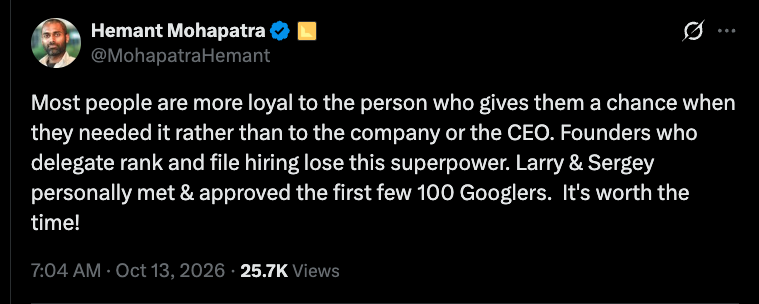
(This was the tweet that actually led to the idea for this post.)
Founders may bet on people others pass on
As a founder, when you hire people, you are not only filling “a role”, you are indirectly doing “org design”. You are not only looking at what the person can do today, you are looking at what the org will look like next year, how this person fits into that story, and the year after that and so on. Other hiring managers can do this too, but they need access to that broader context.
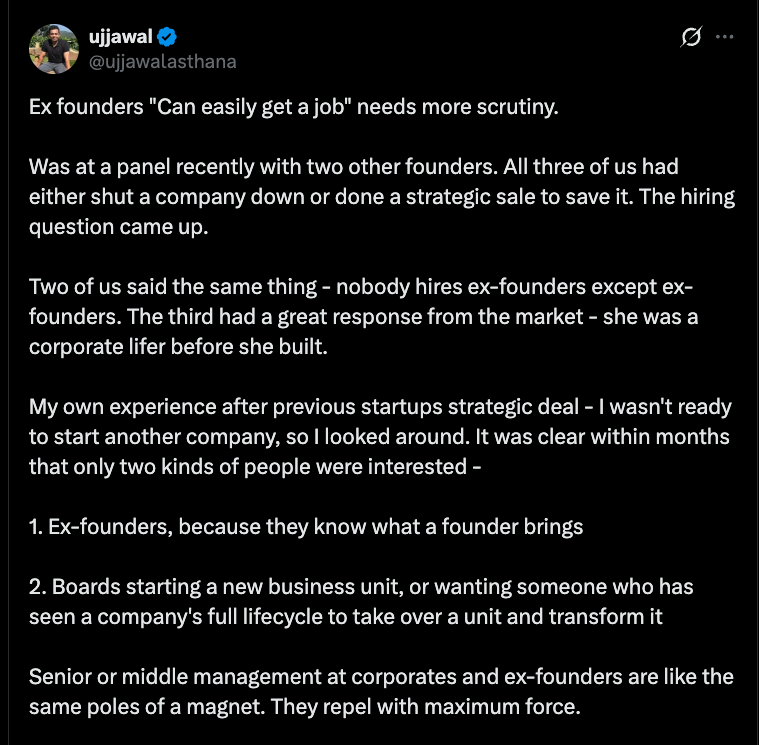
Ujjawal’s experience of looking for a role as an ex-founder is one example of how differently people can assess the same background. It does not establish that founders are always better judges of talent, but it illustrates the point about perspective.
Ujjawal Asthana’s post on hiring ex-founders
Founders need to help raise the bar for talent
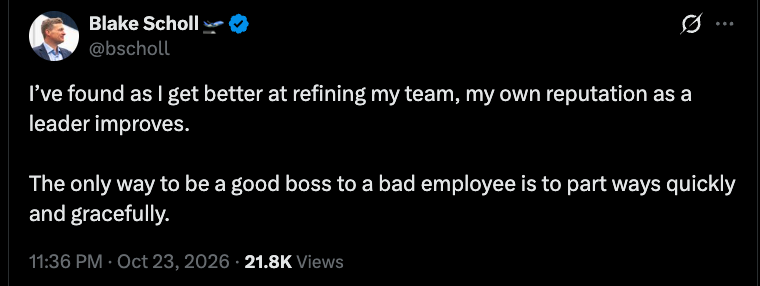
One of the critical parts of raising talent density and getting better as a team/company is being willing to make hard calls when a person and a role no longer fit. As much as you bet on talent as a founder, there are times when people don’t scale up, can’t keep up, or the role changes. It does not always mean that hiring was flawed; it simply means the hiring process is not a perfect predictor of how people will perform as the company grows.
Before concluding that someone can’t keep up, you need to ask whether expectations were clear and whether they had the feedback and support to grow. Sometimes a different role is the answer. Sometimes parting ways is. It is a hard thing to do, but as a founder you need to take responsibility for the decision and how it is handled.
Blake Scholl’s post on making difficult team decisions